

BLOG
Front vs Rear Driveshaft: What’s the Difference and Which One Wears Out Faster?
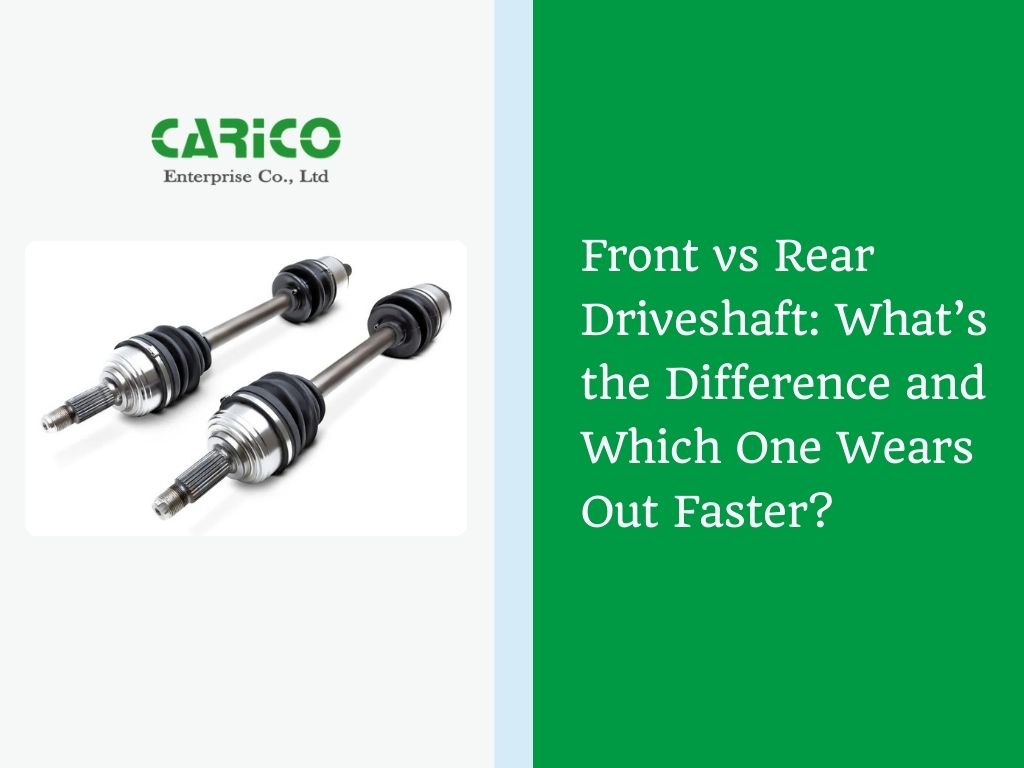
For businesses involved in the automotive aftermarket, understanding essential driveline components is key to providing the right solutions to customers. The driveshaft is a part that often gets overlooked, yet it plays a vital role in efficient power delivery and safe driving performance. But not all driveshafts are the same—depending on the drivetrain layout, a vehicle may use a front driveshaft, rear driveshaft, or both. And each is subject to different types of stress and wear.
In this guide, we explain the differences between front and rear driveshafts, which one typically wears out faster, common failure symptoms, and what to consider when selecting high-quality replacements.
What Does a Driveshaft Do?
A driveshaft—also known as a propeller shaft—transfers torque from the transmission or transfer case to the differential, enabling the wheels to rotate. It works alongside key components such as:
- U-joints for rotational flexibility
- Slip yokes for length adjustment during suspension movement
- Center support bearings in multi-section shafts
Without a properly functioning driveshaft, power delivery becomes unstable, leading to vibration, noise, or even the inability to move the vehicle.
Front vs Rear Driveshaft: Key Differences
| Component Type | Where Used | Main Function | Common Vehicle Types |
|---|---|---|---|
| Front Driveshaft | Between transfer case → front differential | Delivers power to front wheels in 4WD/AWD | Pickup trucks, SUVs, AWD vehicles |
| Rear Driveshaft | Transmission/transfer case → rear differential | Main power delivery to rear wheels | RWD, 4WD, AWD vehicles |
Because AWD/4WD systems power both axles, the front driveshaft typically has a more complex role, needing more articulation to follow steering and suspension movement.
Which Driveshaft Wears Out Faster?
In most cases:
☛ The front driveshaft tends to wear out faster—especially in AWD and 4WD vehicles.
Reasons:
- Handles constant angle changes from steering and suspension travel
- Often exposed to more dirt, water, and off-road debris
- Works continuously in AWD systems, even during normal road driving
However, the rear driveshaft may wear faster in:
- RWD sedans under high mileage
- Pickup trucks carrying heavy loads
- Vehicles frequently towing trailers
Wear rate ultimately depends on driving style, environment, and drivetrain layout.
Common Signs of Driveshaft Problems
- Vibration in the floor or chassis at certain speeds
- Clunking noises during acceleration or gear shifts
- Squeaking noises at low speed (often U-joint related)
- Difficulty turning due to binding joints
- Visible grease leakage or rusted U-joints
Drivers should never ignore these issues—continuing to drive may cause differential or transmission damage.
What Causes Driveshaft Wear?
- Lack of U-joint lubrication
- Off-road driving or exposure to mud and water
- Corrosion from road salt
- Driveshaft imbalance due to impact or deformation
- Excessive torque from performance upgrades or towing
Proper inspection intervals and preventive maintenance can greatly extend driveshaft life.
How to Choose the Right Replacement Driveshaft
- Exact match for vehicle make, model, year, and drivetrain configuration
- OEM-level or improved materials (ex. carbon steel tubing, precision-hardened U-joints)
- Dynamic balancing to prevent vibration issues
- Compliance with international durability and safety standards
Selecting the wrong driveshaft could lead to alignment problems, rapid wear, or system failure.
How Carico Ensures Quality You Can Rely On
As a professional auto parts supplier, Carico delivers high-performance driveshaft solutions designed for global B2B markets. We support our partners with:
- OEM-fit driveshafts for major vehicle brands
- High durability for diverse road and climate conditions
- Noise-reducing engineering to improve driving comfort
- International-standard manufacturing and quality checks
- Commitment to consistent performance and long service life
We remain focused on helping customers reduce warranty issues and increase end-user satisfaction.
FAQ: Driveshafts for Automotive Applications
Q1. Can I continue driving with a worn driveshaft?
A: It is not recommended. A failing driveshaft can cause severe vibration and may damage the transmission or differential, leading to a more costly repair.
Q2. How long does a driveshaft typically last?
A: Under normal driving, many driveshafts last 100,000–200,000 km. Off-road use, heavy towing, or poor lubrication can shorten lifespan.
Q3. Do driveshafts need regular maintenance?
A: Yes. Many U-joints require periodic lubrication. Routine inspection helps spot rust, cracks, and loose joints early.
Q4. What material is best for replacement driveshafts?
A: Most OE applications use steel for strength and cost-efficiency. Aluminum and carbon fiber driveshafts are lightweight performance options.
Q5. Can a damaged U-joint be replaced without replacing the entire driveshaft?
A: Yes, if the shaft tube and yokes are still in good condition. If wear is widespread, replacing the whole assembly is safer.
Conclusion
Front and rear driveshafts operate in different conditions and therefore experience different wear patterns. While front driveshafts typically wear faster in AWD/4WD vehicles, the rear driveshaft may degrade sooner in RWD or heavy-load applications. Identifying symptoms early and choosing a high-quality replacement ensures smooth power transfer, reduced vibration, and improved safety.
If you’re looking for reliable driveshaft supply for your aftermarket catalog or distribution business—
✉ Contact Carico today. We provide trusted driveline solutions to support your growth in the global automotive market.