

BLOG
The Critical Link: Why You Should Replace Rack Ends and Tie Rod Ends Together?
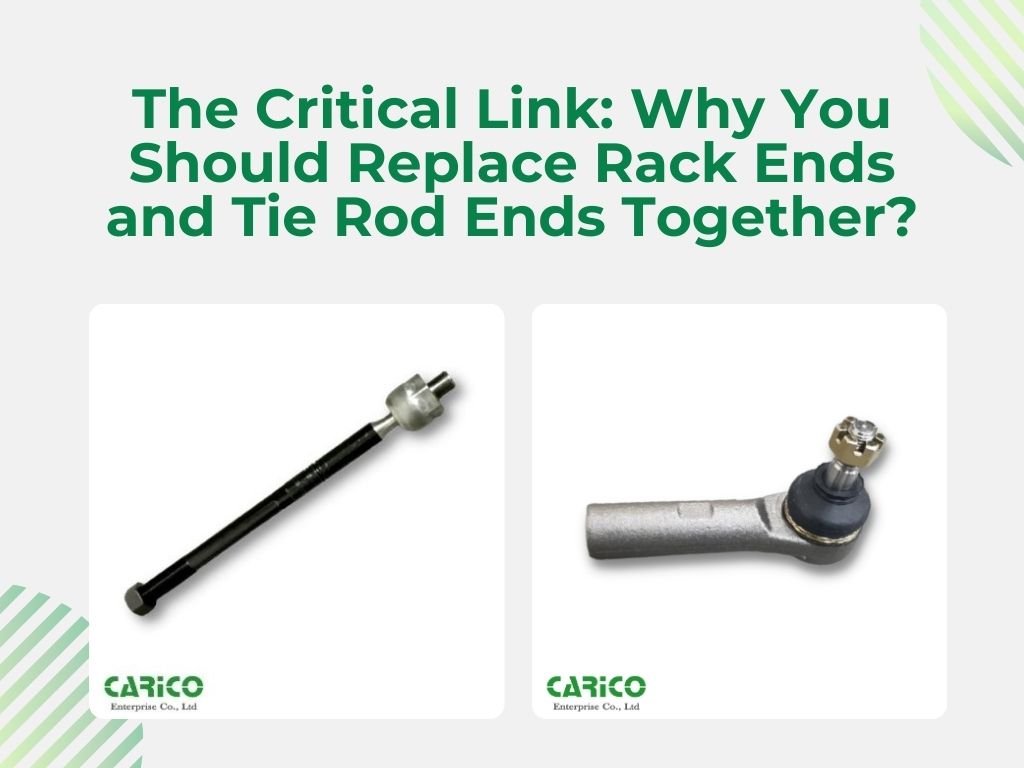
In the world of automotive steering and suspension, precision is everything. At Carico Enterprise Co., Ltd., with over 35 years of manufacturing excellence in Taiwan, we have seen how even the smallest amount of "play" in a steering system can lead to significant safety risks.
One of the most common questions we receive from our global B2B partners—distributors, wholesalers, and workshop managers—is whether it is truly necessary to replace the Rack End (Inner Tie Rod) and the Tie Rod End (Outer Tie Rod) at the same time.
While it may be tempting to replace only the visibly damaged part to save on immediate costs, the technical reality is that these two components function as a single, synchronized unit. In this article, we explore why the "simultaneous replacement" strategy is the gold standard for vehicle safety, mechanical longevity, and business reputation.
1. Understanding the Unified Steering Geometry
To understand why they should be replaced together, we must first look at their relationship. The steering system is a chain of command: the steering gear pushes the Rack End, which pivots within the steering rack boot, and transmits that force to the Tie Rod End, which finally turns the steering knuckle and the wheels.
- The Rack End acts as the pivot point for vertical suspension movement.
- The Tie Rod End manages the angular force required to turn the wheels.
Because they are physically connected and operate under the same road conditions, they endure the same stressors. If a vehicle has hit a pothole or a curb hard enough to damage the ball joint of a Tie Rod End, the shockwave has invariably traveled through the Rack End as well. At Carico, our engineering team designs these parts to work in harmony.
2. The "Domino Effect" of Component Wear
One of the primary reasons we recommend dual replacement is the wear synchronization factor.
When you install a brand-new, stiff Tie Rod End onto a worn, loose Rack End, you create an imbalance in resistance. The new part will have zero play, forcing the remaining old part to absorb a disproportionate amount of vibration and road shock. This often leads to the "second part" failing just a few months after the first repair.
For a professional workshop or a fleet manager, this results in:
- Comebacks: Customers returning shortly after a repair with the same "clunking" noise.
- Labor Inefficiency: Having to disassemble the steering assembly twice for a job that could have been handled once.
- Increased Warranty Claims: For distributors, this often manifests as "defective" parts that were actually just installed alongside worn-out components.
3. The Hidden Cost: Alignment Expenses
This is perhaps the most compelling economic argument for replacing both parts simultaneously. Every time a Rack End or Tie Rod End is replaced, the vehicle must undergo a professional wheel alignment.
Wheel alignments are precise and relatively expensive. If you replace the Tie Rod End today and the Rack End four months from now, the customer pays for two alignments. By replacing the "Critical Link" in one visit, you ensure the alignment holds for the long term, protecting the customer’s tires from uneven wear.
4. The Carico Quality Advantage: Engineering for Durability
At Carico, we don't just manufacture parts; we manufacture trust. Our commitment to quality is reflected in every stage of our production:
- ISO 9001 Certified Excellence: Our manufacturing facility is ISO 9001 certified and based in Taiwan. This ensures that every Rack End and Tie Rod End undergoes a standardized quality control process.
- Precision Technology & Design: We utilize advanced 3D/2D scanning and drawing technologies to ensure perfect fitment, especially for Japanese, American, and Korean vehicles.
- Automated Production & Integrated Process: By integrating automatic production machinery, we increase efficiency while maintaining strict quality standards.
- Rigorous Testing & Attentive Assembly: All parts are thoroughly tested to comply with ISO standards, ensuring that your order arrives in optimal condition.
5. Safety: The Ultimate Priority
Beyond the economics of repair lies the fundamental issue of driver safety. A failed Rack End or Tie Rod End can lead to a total loss of steering control. Steering components usually don't fail catastrophically without warning; they start with subtle symptoms like vibrations in the steering wheel or "wandering" on the highway.
Frequently Asked Questions (FAQ)
Q1: Can I just replace the Rack End and skip the Tie Rod End if it looks okay?
A: While it is mechanically possible, we highly discourage it. Replacing them together avoids the cost of a second labor fee and a second wheel alignment.
Q2: How often should I check the Rack Ends and Tie Rod Ends?
A: We recommend a thorough inspection every 20,000 to 30,000 kilometers, or during every routine oil change.
Q3: Are Carico steering parts compatible with all vehicle makes?
A: Carico specializes in a wide range of applications, particularly for Japanese, American, and Korean vehicles, meeting exact OE specifications.
Q4: Does replacing these parts affect my vehicle's alignment?
A: Yes, absolutely. A professional wheel alignment is mandatory after installation to ensure safety and prevent tire wear.
Conclusion: A Proactive Approach to Maintenance
In the competitive B2B automotive aftermarket, recommending the replacement of both Rack Ends and Tie Rod Ends is a professional best practice that ensures safety and preserves the integrity of the steering system.
As a leading manufacturer in Taiwan, Carico Enterprise Co., Ltd. remains committed to supporting our partners with the highest quality steering and suspension components.
[Contact our sales team today to request our latest product catalog.]