

BLOG
How Disc Brake Pads and Brake Discs Work Together for Better Braking Performance
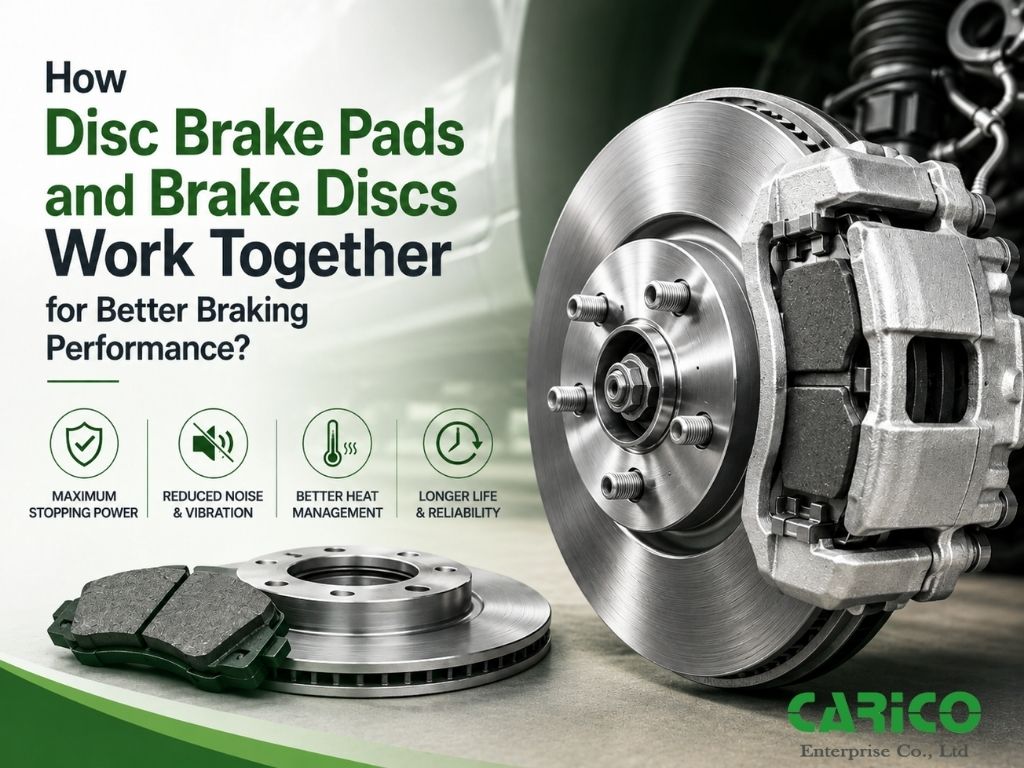
When discussing vehicle braking performance, disc brake pads and brake discs are often considered separately. In reality, these two components function as a matched friction system. The condition, material, and compatibility of one directly influence the performance and service life of the other.
When the driver presses the brake pedal, the brake caliper pushes the disc brake pads against the rotating brake disc. The resulting friction converts the vehicle's kinetic energy into heat, allowing the vehicle to slow down or stop. For this process to remain smooth, predictable, and safe, both surfaces must work together effectively.
Understanding this relationship is important not only for vehicle owners and repair professionals but also for aftermarket distributors selecting reliable braking components for different vehicle applications.
Table of Contents
- How Disc Brake Pads and Brake Discs Work Together
- Why Brake Pad Material Matters
- The Brake Disc Is Equally Important
- What Happens When Brake Pads and Discs Do Not Work Properly Together?
- Heat Management Affects Both Components
- New Disc Brake Pads? Don't Ignore the Brake Disc
- Why Quality Matters for Aftermarket Brake Components
- FAQ About Disc Brake Pads and Brake Discs
- Conclusion
How Disc Brake Pads and Brake Discs Work Together
A disc brake system consists of several interconnected components, including the brake caliper, brake pads, brake disc, hydraulic system, and related hardware.
During braking, hydraulic pressure activates the caliper pistons, which press the disc brake pads against both sides of the brake disc. Friction between the pad material and disc surface creates the braking force required to reduce wheel speed.
This means braking performance does not depend solely on how "strong" a brake pad is. The friction characteristics of the pads must work appropriately with the brake disc surface while remaining stable across different speeds, temperatures, and driving conditions.
A well-matched combination can provide predictable braking response, controlled wear, and smoother operation. A poor combination, however, may contribute to noise, vibration, excessive heat, or accelerated component wear.
Why Brake Pad Material Matters
Disc brake pads are available in different friction material formulations, and each behaves differently when interacting with a brake disc.
Organic brake pads are generally designed to provide relatively quiet and smooth operation, although their wear characteristics may make them less suitable for demanding applications. Semi-metallic pads contain metallic components that can provide strong braking performance and good heat resistance but may generate more noise or disc wear depending on the formulation.
Ceramic brake pads are another common option, particularly in passenger vehicle applications where low noise, reduced dust, and consistent performance are desirable.
There is therefore no single brake pad material that is automatically "best" for every vehicle. Vehicle weight, braking system design, operating temperature, driving environment, and brake disc compatibility all need to be considered.
Common Disc Brake Pad Types
| Brake Pad Type | General Characteristics | Common Considerations |
|---|---|---|
| Organic | Smooth operation and generally lower noise | May wear faster under demanding conditions |
| Semi-Metallic | Good heat resistance and strong braking characteristics | Can produce more noise and may increase disc wear |
| Ceramic | Stable performance, lower noise and typically less visible dust | Suitability depends on vehicle and braking system design |
Choosing the appropriate friction material helps the brake pads and discs operate as an effective system rather than as two independent replacement parts.
The Brake Disc Is Equally Important
Installing high-quality disc brake pads cannot compensate for a brake disc that is excessively worn, damaged, or unsuitable for continued use.
The brake disc provides the friction surface against which the pads operate. Its surface condition, thickness, dimensional accuracy, and ability to manage heat all influence braking behavior.
For example, a disc with excessive thickness variation or surface irregularities may contribute to vibration or pulsation during braking. Deep grooves and abnormal wear can also prevent new pads from contacting the disc surface evenly.
This is why technicians should inspect the brake discs whenever replacing brake pads rather than automatically assuming that only the pads require attention.
What Happens When Brake Pads and Discs Do Not Work Properly Together?
Compatibility problems do not always cause immediate brake failure. More commonly, drivers begin noticing smaller changes in braking behavior.
A mismatched or deteriorated pad-and-disc combination may result in increased braking noise, vibration, uneven pad wear, reduced braking consistency, or excessive heat generation. In some situations, one component may simply wear much faster than expected because the friction characteristics are not suitable for the application.
The relationship can be summarized as follows:
| Condition | Possible Effect |
|---|---|
| Worn brake pads + good brake disc | Reduced braking performance and possible disc damage if wear becomes severe |
| New brake pads + badly worn disc | Uneven contact, noise, vibration, or accelerated pad wear |
| Incorrect pad material for application | Excessive heat, noise, wear, or inconsistent braking characteristics |
| Properly matched pads and discs | More consistent braking, controlled wear, and predictable performance |
This is why evaluating the complete friction pair is more effective than looking at either component independently.
Heat Management Affects Both Components
Heat is one of the most important factors influencing braking performance.
Every braking event converts kinetic energy into thermal energy. During normal driving, the braking system has time to dissipate much of this heat. During repeated hard braking, mountain driving, heavy traffic, towing, or other demanding conditions, temperatures can rise considerably.
Disc brake pads must maintain suitable friction characteristics as temperatures change, while the brake disc must absorb and dissipate heat without excessive distortion.
If either component performs poorly under heat, braking consistency can decline. Excessive temperature may accelerate pad wear, affect the disc surface, and contribute to brake fade.
Therefore, selecting braking components according to actual vehicle usage is just as important as choosing the correct dimensions.
New Disc Brake Pads? Don't Ignore the Brake Disc
When replacing disc brake pads, the brake disc should always be inspected at the same time.
Technicians typically evaluate factors such as remaining disc thickness, surface condition, scoring, cracks, corrosion, and abnormal wear. Measurements should be compared with the vehicle or component manufacturer's service specifications.
Installing new pads against an unsuitable disc surface can prevent proper contact between the two components. This may reduce braking consistency and shorten the life of the newly installed pads.
The bedding-in process after installation is also important. New pads need appropriate contact with the disc surface to establish stable friction behavior. Following the brake component or vehicle manufacturer's bedding procedure can help the new friction pair perform as intended.
Why Quality Matters for Aftermarket Brake Components
For aftermarket distributors and repair businesses, braking components are safety-critical products. Product quality therefore affects more than replacement frequency—it also influences customer confidence, warranty issues, and long-term business reputation.
Accurate fitment is particularly important. Brake pads and discs must correspond to the correct vehicle application and braking system specifications. Material consistency, dimensional accuracy, and manufacturing quality also contribute to predictable performance from one replacement to another.
Carico is an experienced auto parts supplier serving global aftermarket customers with a broad range of automotive components, including disc brake pads, brake discs, brake calipers, as well as steering and suspension parts. By offering multiple brake system components, Carico helps distributors and automotive professionals source products for diverse vehicle applications.
FAQ About Disc Brake Pads and Brake Discs
Do brake pads and brake discs need to be replaced at the same time?
Not necessarily. Brake pads generally wear faster than brake discs. However, the disc should be inspected whenever pads are replaced. If it has reached its minimum allowable thickness or shows significant damage or abnormal wear, replacement may also be necessary.
Can new disc brake pads be installed on old brake discs?
They can be if the existing brake discs remain within specification and are in suitable condition. Excessively worn, damaged, cracked, or irregular disc surfaces may affect the performance and lifespan of new pads.
Why do new brake pads sometimes make noise?
Brake noise can have several causes, including improper installation, unsuitable friction material, disc surface condition, hardware problems, contamination, or incomplete bedding-in. The pads should not automatically be assumed to be the only cause.
Which disc brake pad material is best?
There is no universal answer. Organic, semi-metallic, and ceramic formulations offer different characteristics. The correct choice depends on vehicle specifications, brake system design, driving conditions, and the intended application.
Can worn brake pads damage the brake disc?
Yes. If brake pads are worn beyond their usable friction material, their backing plates or other components can contact the disc and cause severe scoring or damage. Timely inspection and replacement are therefore important.
Conclusion: Better Braking Starts with the Right Pad-and-Disc Combination
Disc brake pads and brake discs should be considered as a working pair rather than isolated components. The pads provide the friction material, while the disc provides the rotating surface needed to convert vehicle motion into heat. Their material characteristics, condition, fitment, and ability to manage temperature all influence overall braking performance.
Choosing the correct components and inspecting both sides of the friction system during maintenance can help achieve more consistent braking, controlled wear, and longer component life.
For aftermarket distributors and automotive professionals looking for dependable brake system components, contact Carico today to learn more about our disc brake pads, brake discs, brake calipers, and other automotive parts for a wide range of vehicle applications.
Related Articles
What Are Disc Brake Pads and Why Are They Important for Vehicle Safety?
Learn how disc brake pads work, why they are critical for braking safety, and what factors should be considered when selecting and maintaining brake pads.
Top 7 Signs Your Disc Brake Pads Need Replacement
Discover the most common warning signs of worn disc brake pads and learn when inspection or replacement may be necessary to maintain braking performance.