

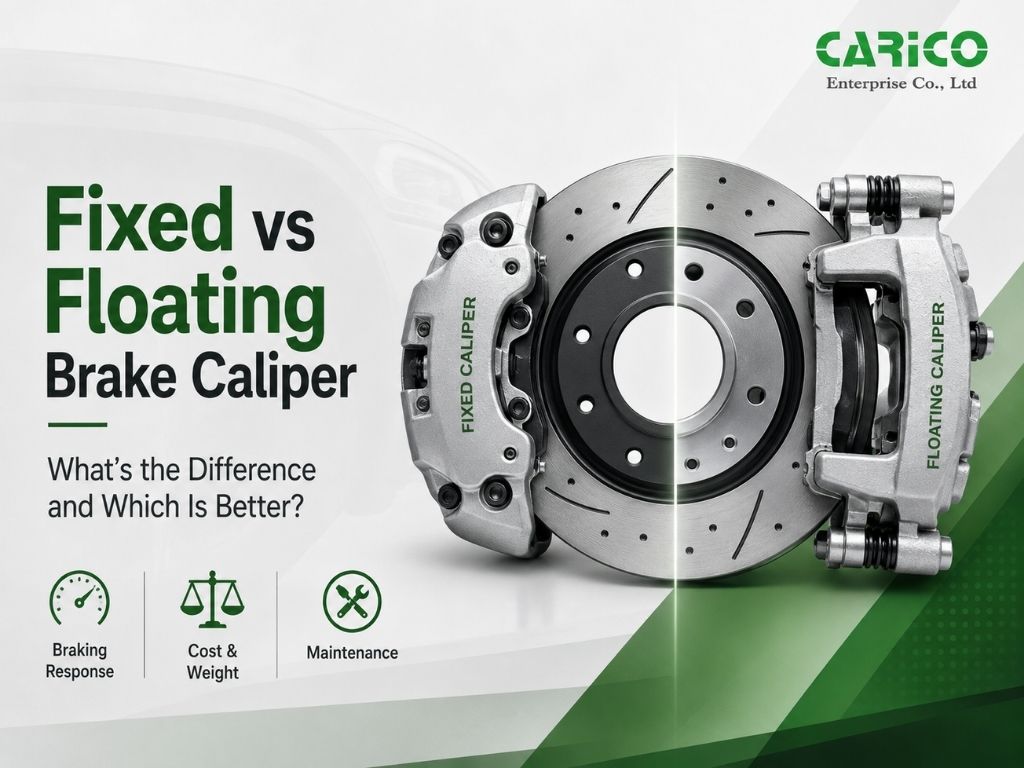
When choosing or replacing a brake caliper, one of the most common distinctions is whether the vehicle uses a fixed or floating design. Both types perform the same essential task—pressing the brake pads against the brake disc to slow the vehicle—but they achieve this in different ways.
Understanding the differences between a fixed vs floating brake caliper is important because caliper design can affect braking response, weight, cost, maintenance requirements, and suitability for different vehicle applications. Neither design is automatically better for every vehicle.
This guide explains how fixed and floating brake calipers work, compares their advantages and limitations, and helps you understand which design is more appropriate for different driving requirements.
Table of Contents
- What Is a Fixed Brake Caliper?
- What Is a Floating Brake Caliper?
- Fixed vs Floating Brake Caliper: Key Differences
- Does a Fixed Brake Caliper Provide Better Braking Performance?
- Why Are Floating Brake Calipers So Common?
- Maintenance Differences Between Fixed and Floating Brake Calipers
- Which Is Better: Fixed or Floating Brake Caliper?
- Why Brake Caliper Quality Still Matters
- Frequently Asked Questions
- Conclusion: Choose the Brake Caliper That Matches the Vehicle
- Related Articles
What Is a Fixed Brake Caliper?
A fixed brake caliper is mounted rigidly in position over the brake disc and does not move laterally during braking. Pistons are positioned on both sides of the disc, allowing the brake pads to be pushed inward simultaneously.
When hydraulic pressure is applied, the opposing pistons press both pads against the brake disc. Because braking force can be distributed across multiple pistons, fixed calipers can provide precise and consistent clamping force.
Fixed calipers are commonly associated with performance-oriented vehicles and applications where strong, repeatable braking is important. Depending on the design, they may use two, four, six, or even more pistons.
However, the additional pistons and more complex caliper construction generally make fixed calipers larger, more complex, and more expensive than typical floating designs.
What Is a Floating Brake Caliper?
A floating brake caliper, sometimes called a sliding caliper, operates differently. Instead of having opposing pistons on both sides of the brake disc, most floating designs use one or more pistons on the inboard side of the caliper.
When the brake pedal is pressed, hydraulic pressure pushes the piston and inner brake pad toward the disc. At the same time, the caliper body slides along guide pins, pulling the outer pad against the opposite side of the disc.
This sliding action allows a relatively simple mechanism to clamp both sides of the brake disc.
Because fewer pistons and components are required, floating brake calipers can be lighter, more compact, and more economical to manufacture. These characteristics make them widely used in passenger cars and many everyday vehicles.
Fixed vs Floating Brake Caliper: Key Differences
Although both designs ultimately perform the same braking function, the way they generate clamping force creates several practical differences.
| Comparison | Fixed Brake Caliper | Floating Brake Caliper |
|---|---|---|
| Caliper Movement | Caliper body remains fixed | Caliper slides laterally on guide pins |
| Piston Arrangement | Pistons on both sides of the brake disc | Usually piston(s) on one side |
| Construction | More complex | Simpler and more compact |
| Braking Response | Precise and consistent | Well suited to normal daily driving |
| Weight | Often heavier depending on design and material | Generally lighter and more compact |
| Cost | Typically higher | Generally more economical |
| Maintenance | More components may increase service complexity | Guide pins and sliding surfaces require proper maintenance |
| Common Applications | Performance and demanding braking applications | Passenger cars and mainstream vehicles |
The key difference is therefore not simply the number of pistons. A fixed caliper applies force from both sides without moving the caliper body, while a floating caliper relies on sliding movement to create clamping force on both sides of the brake disc.
Does a Fixed Brake Caliper Provide Better Braking Performance?
Fixed brake calipers can offer advantages when a braking system must handle demanding conditions.
Because pistons act directly on both sides of the brake disc, braking pressure can be distributed more evenly across the brake pads. Multi-piston configurations can also help maintain consistent pad contact, which is particularly valuable during repeated hard braking.
For performance vehicles, this can contribute to more predictable pedal response and consistent braking behavior.
However, installing a fixed caliper does not automatically make a vehicle stop faster. Overall braking performance depends on the complete braking system, including the brake pads, brake discs, tires, hydraulic system, vehicle weight, and electronic control systems.
For ordinary passenger vehicles, a properly designed floating brake caliper can provide more than sufficient braking performance while keeping cost, weight, and maintenance requirements under control.
Why Are Floating Brake Calipers So Common?
If fixed calipers can provide excellent braking performance, why do so many vehicles use floating calipers?
The answer comes down to efficiency and application requirements.
Most passenger vehicles do not require the braking characteristics of a large multi-piston fixed caliper. Manufacturers must balance braking performance with vehicle weight, packaging space, manufacturing cost, maintenance, and fuel efficiency.
A floating brake caliper achieves this balance particularly well. Its simpler construction requires fewer components, occupies less space around the wheel, and can provide reliable braking performance for normal city and highway driving.
This makes floating calipers a practical solution rather than an inferior one. The appropriate caliper design depends on what the vehicle is engineered to do.
Maintenance Differences Between Fixed and Floating Brake Calipers
Maintenance requirements are another important difference between the two designs.
For a floating caliper to work correctly, it must slide smoothly along its guide pins. Dirt, corrosion, damaged boots, or insufficient lubrication can prevent proper movement. A sticking guide pin may cause uneven brake pad wear, brake drag, overheating, or reduced braking efficiency.
Fixed calipers do not depend on this sliding mechanism, but their multiple pistons and seals introduce other maintenance considerations. If one piston becomes corroded or begins sticking, braking pressure may no longer be distributed evenly across the pad.
In either system, regular inspection of the pistons, seals, dust boots, brake pads, and surrounding components is important. Brake caliper performance depends not only on the original design but also on the condition of the complete assembly.
Which Is Better: Fixed or Floating Brake Caliper?
There is no universal winner in the fixed vs floating brake caliper comparison.
For performance-oriented vehicles or applications involving repeated heavy braking, fixed calipers may provide advantages in braking consistency and force distribution. For passenger vehicles and everyday driving, floating calipers offer an effective combination of braking performance, compact size, simpler construction, and cost efficiency.
The better question is therefore not simply, “Which caliper is better?” but rather:
Choosing a replacement based only on piston count or perceived performance can lead to incorrect fitment or an unsuitable braking setup. Vehicle specifications, caliper mounting, brake disc dimensions, hydraulic requirements, and intended operating conditions all need to be considered.
Why Brake Caliper Quality Still Matters
Whether a vehicle uses a fixed or floating brake caliper, product quality remains essential.
A floating caliper requires accurate guide surfaces and reliable sliding components to maintain even braking. A fixed caliper requires precise piston bores and consistent piston movement to distribute force properly. In both cases, dimensional accuracy, sealing quality, corrosion resistance, and correct fitment can influence long-term performance.
This is especially important for aftermarket distributors and repair businesses. A caliper that fits incorrectly or develops premature sticking can result in uneven pad wear, customer complaints, repeat repairs, and additional warranty costs.
As an experienced auto parts supplier, Carico provides a broad range of automotive components for braking, steering, suspension, and other vehicle systems. By providing brake components for different vehicle applications, Carico helps aftermarket customers source the appropriate replacement parts for their target markets.
Frequently Asked Questions About Fixed and Floating Brake Calipers
1. Can a Floating Brake Caliper Have More Than One Piston?
Yes. Although many floating brake calipers use a single piston, some designs use more than one piston on the inboard side. The defining characteristic of a floating caliper is not the number of pistons, but the fact that the caliper body slides laterally to bring both brake pads into contact with the brake disc.
2. What Causes Uneven Brake Pad Wear on a Floating Caliper?
A floating brake caliper must move smoothly along its guide pins. Dirt, corrosion, damaged protective boots, or insufficient lubrication can restrict this movement.
When the caliper cannot slide properly, it may lead to uneven brake pad wear, brake drag, overheating, or reduced braking efficiency. Inspecting the guide pins, boots, lubrication condition, and pad wear pattern can help identify potential caliper movement problems.
3. What Should Be Checked When Replacing a Brake Caliper?
Brake caliper replacement should be based on the vehicle’s original braking system and fitment requirements.
Important factors include the caliper mounting configuration, brake disc dimensions, hydraulic requirements, piston configuration, and intended operating conditions. Choosing a replacement based only on piston count or perceived braking performance may result in incorrect fitment or an unsuitable braking setup.
Conclusion: Choose the Brake Caliper That Matches the Vehicle
The main difference between a fixed and floating brake caliper lies in how braking force is applied. Fixed calipers remain stationary and use pistons on both sides of the brake disc, while floating calipers slide laterally to bring both brake pads into contact with the disc.
Fixed calipers can be advantageous for demanding braking applications where consistent force distribution is important. Floating calipers, meanwhile, provide reliable braking with a simpler, compact, and cost-effective design that makes them suitable for a wide range of passenger vehicles.
Ultimately, the right choice should be based on the vehicle's original braking system, fitment requirements, and intended use rather than assuming one design is always superior.
For distributors and automotive businesses looking for reliable replacement brake components, contact Carico today to discuss your vehicle applications and sourcing requirements. Our team can help you find suitable automotive parts for your aftermarket product range.